Joseph Smith–History
The Pearl of Great Price Student Manual, (2000), 52–65
What Is Joseph Smith—History?
Joseph
Smith—History tells of the Prophet’s experiences from his early years
through May 1829. It was extracted by Elder Franklin D. Richards, who
was a member of the Quorum of the Twelve Apostles, from a much longer
history the Prophet Joseph Smith began in 1838. The extract was first
published in England in 1851 as part of the first Pearl of Great Price
pamphlet (see the Introductory Note at the beginning of the Pearl of Great Price).

Joseph
Smith—History contains an account of the First Vision, the coming forth
of the Book of Mormon, and the restoration of the Aaronic and
Melchizedek Priesthoods. The excerpts come from the first five chapters
of what eventually became the seven-volume History of the Church (see 1:1–44).
Joseph Smith—History became scripture in 1880 when the Pearl of Great
Price was canonized as one of the standard works of the Church.
Who Wrote Joseph Smith—History?
The
account in the Pearl of Great Price was not the first attempt to record
the Prophet’s early experiences. In April 1830 he received a revelation
from the Lord requiring that a record or history be kept (see D&C 21:1).
However, his efforts were hindered by lawsuits, imprisonments, poverty,
and mobs. Oliver Cowdery “served as Church Recorder from April 1830 to
March 1831 and again from September 1835 to 1837. He wrote a history of
the Church covering the period from ‘the time of the finding of the
plates up to June 12th, 1831’” (Dean C. Jessee, “The Writing of Joseph
Smith’s History,” Brigham Young University Studies,
summer 1971, 442). In March 1831, John Whitmer was appointed to “write
and keep a regular history, and assist you, my servant Joseph, in
transcribing all things which shall be given you” (D&C 47:1).
John Whitmer’s brief written history was lost for many years, but is
now available. Oliver Cowdery also wrote eight letters about Joseph
Smith’s early visions, which were published in the Latter Day Saints’ Messenger and Advocate in 1834–35.
Joseph
Smith commenced work on a history between July and November 1832. It
began with the words “A History of the life of Joseph Smith Jr., an
account of his marvelous experience and of all the mighty acts which he
doeth in the name of Jesus Christ the son of the living God of whom he
beareth record and also an account of the rise of the church of Christ”
(Dean C. Jessee, “The Early Accounts of Joseph Smith’s First Vision,” Brigham Young University Studies, spring 1969, 278).
Various
clerks and historians began three more historical accounts between 1834
and 1836. In the difficult years of 1837 and 1838, Joseph Smith and the
First Presidency worked on the history of the Church, sometimes taking a
grammar lesson before the writing sessions. Finally, in June 1839, the
Prophet undertook the work again. Materials from the previous efforts
were assimilated into a new history, which eventually was published in
the Times and Seasons beginning 1 March
1842. Elder Franklin D. Richards published extracts from that 1842
history in 1851, and they are now called Joseph Smith—History.
Some Fundamental Messages of Joseph Smith—History
- •
The reality of Heavenly Father and Jesus Christ as the Savior of the world.
Joseph Smith left the Sacred Grove with a personal knowledge of the
reality of our Heavenly Father and Jesus Christ. He knew that Jesus is
the Son of God; that because of the mercy and grace of His Atonement his
sins were forgiven; that Heavenly Father was pleased with His Son, the
Savior; and that he was to listen to and obey the words of the Savior.
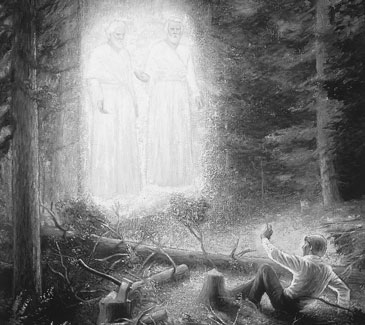
- • There was an apostasy and loss of the true Church from the earth. Joseph was told to join none of the churches, “for they were all wrong” (Joseph Smith—History 1:19). Such a statement makes it clear that the gospel and church established by the Savior during His mortal ministry had been lost and that “none of them was acknowledged of God as His Church and kingdom” (History of the Church, 4:536).
- • Joseph Smith was a prophet of God. Joseph wrote that the angel Moroni told him that “God had a work for me to do” (Joseph Smith—History 1:33). Every event in the Restoration of the gospel through the Prophet Joseph Smith chronicles the fact that God had spoken again to man through a prophet.
- • The Book of Mormon is the word of God. The events surrounding the coming forth of the Book of Mormon testify of its divinity, and its message not only testifies of Christ, but is a catalyst for greater revelation from God and for the gathering of scattered Israel into the church and kingdom of God.
- • The Church of Jesus Christ has been restored to earth in the latter days. Joseph was promised that the fulness of the gospel would be made known through him (see History of the Church, 4:536). The translation of the Book of Mormon and the restoration of the priesthood laid the foundation for the reestablishment of the church and kingdom of God on earth.
Joseph Smith–History 1:1–10
An Unusual Excitement
|
Date |
Significant Event |
|---|---|
|
23 December 1805 |
Joseph Smith Jr. was born in Sharon township, Windsor County, Vermont. |
|
1816 |
The Smith family moved from Norwich, Vermont, to Palmyra, New York (near where the Book of Mormon plates were buried). |
|
1820 |
An unusual excitement on the subject of religion led young Joseph to wonder which church to join. |
Joseph Smith—History 1:1. What Were the “Many Reports … by Evil-Disposed and Designing Persons”?
“From
the outset the Church had an unpopular public image that was added to
by apostates and nurtured by the circulation of negative stories and
articles in the press. People gave many reasons for apostatizing. For
example, Norman Brown left the Church because his horse died on the trip
to Zion. Joseph Wakefield withdrew after he saw Joseph Smith playing
with children upon coming down from his translating room. Simonds Ryder
denied Joseph’s inspiration when Ryder’s name was misspelled in his
commission to preach. Others left the Church because they experienced
economic difficulties.
“Ezra Booth, a former Methodist minister, was an influential apostate during this period [the early 1830s]. …
“… He published nine letters in the Ohio Star in Ravenna, from 13 October to 8 December 1831, detailing his objections to the Church.
“These letters … later became a major section of the first anti-Mormon book, … published in 1834” (Church History in the Fulness of Times [Religion 341–43 student manual, 2nd ed., 2000], 113–14).
Many
members of the Church apostatized following a period of economic stress
in 1837. Backbiting against the Prophet Joseph Smith was common in
Kirtland, particularly when he was away on business or on missions. Some
men who held positions of trust in the Church rejected his leadership
and declared that he was no longer a true prophet. “As a result of this
apostasy fifty leading members of the Church were excommunicated under
the direction of Joseph Smith, but the problems continued to fester.
Several apostates tormented the faithful members with lawsuits and
threatened loss of property. Anti-Mormons added their part by
boycotting, ostracizing, and denying employment to those who were true
to the Prophet and the Church” (Church History in the Fulness of Times, 177).
After
settling with his family in Far West, Missouri, Joseph, “with the
assistance of Sidney Rigdon … embarked on the ambitious project of
writing the history of the Church from its beginning. … The history of
Joseph Smith and the early events of the Restoration now found in the
Pearl of Great Price were a product of this project begun in April 1838”
(Church History in the Fulness of Times, 187).
Joseph Smith—History 1:3. What Was Joseph Smith’s Early Life Like?
“Joseph
Smith grew up on the family farm and was almost exclusively under his
family’s influence. … During his formative years, Joseph Smith began to
incorporate and manifest qualities that would help him fulfill his
foreordained mission.
“… He developed strong family bonds, learned to work hard, to think for himself, to serve others, and to love liberty” (Church History in the Fulness of Times, 15).
His
parents, Lucy Mack and Joseph Smith Sr., were married on 24 January
1796 and settled on a family farm in Tunbridge, Vermont. Joseph and Lucy
rented a farm from Solomon Mack, Lucy’s father, in the summer of 1805
and Joseph also taught school in the winter. It was there that their
fifth child, Joseph Smith Jr., was born on 23 December 1805. Lucy and
Joseph taught their children religious precepts and Lucy especially
encouraged the study of the Bible. Joseph Sr. was suspicious of
traditional churches but always retained a strong belief in God.
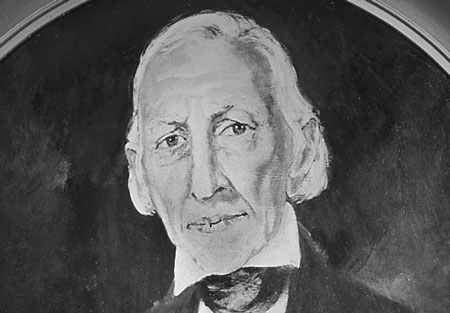
Joseph Smith Sr.
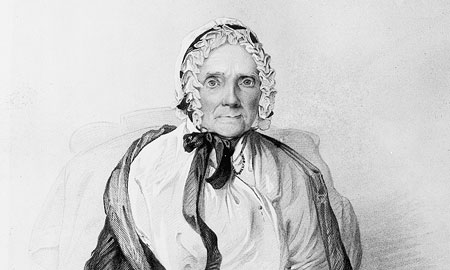
Lucy Mack Smith
“During
Joseph Smith’s earliest years, his family moved frequently, looking for
fertile soil or some other way to earn a livelihood. … In 1811 the
Smiths moved to the small community of West Lebanon, New Hampshire. …
“Seven-year-old
Joseph, Jr., recovered from … [typhoid] after two weeks but suffered
complications that eventually required four surgeries. The most serious
complication involved a swelling and infection in the tibia of his left
leg.” An operation on his leg to remove the infection was endured by
Joseph “without being bound or drinking brandy wine to dull his senses” (Church History in the Fulness of Times, 22–23).
In
1816, Joseph Sr. went to Palmyra, New York, to investigate the report
of good land at low cost. Joseph Jr., at the time a boy of ten,
remembered that even though he was not yet fully recovered from his leg
operation, the teamster engaged to assist the Smiths in their journey
made him walk through snow, forty miles per day for several days, during
which time he suffered the most excruciating weariness and pain.
“Joseph
Smith, Sr., the father of a family of ten—eleven by 1821—worked hard
for a living. After two years in Palmyra, he accumulated enough money
for a down payment on one hundred acres of wooded land in the nearby
township of Farmington. During the first year he and his sons cleared
thirty acres of heavy timber, prepared the ground for cultivation, and
planted wheat. … Young Joseph later recalled that ‘it required the
exertions of all that were able to render any assistance for the support
of the Family’ [“History of Joseph Smith by Himself,” 1]. …
“At
this time Joseph’s opportunities for schooling were limited. He
attributed this to the ‘indigent circumstances’ he was raised under. ‘We
were deprived of the benefit of an education. Suffice it to say, I was
merely instructed in reading, writing, and the ground rules of
arithmetic which constituted my whole literary acquirements’ [“History
of Joseph Smith by Himself,” 1]” (Church History in the Fulness of Times, 29–30).
Joseph Smith—History 1:4. Joseph Smith’s Family
Elder
Carlos E. Asay, who was a member of the Presidency of the Seventy, said
that the Prophet Joseph Smith “was the product of a God-fearing
family—a family that thirsted after righteousness and exercised a simple
but deep faith in the Lord. His school was the home, his teachers were
loving parents, and his textbook was the Holy Bible” (in Conference
Report, Mar.–Apr. 1990, 79; or Ensign, May 1990, 63).
President
Brigham Young said that the Lord had watched over Joseph Smith’s
ancestors for generations: “It was decreed in the counsels of eternity,
long before the foundations of the earth were laid, that he should be
the man, in the last dispensation of this world, to bring forth the word
of God to the people, and receive the fulness of the keys and power of
the Priesthood of the Son of God. The Lord had his eye upon him, and
upon his father, and upon his father’s father, and upon their
progenitors clear back to Abraham, and from Abraham to the flood, from
the flood to Enoch, and from Enoch to Adam. He has watched that family
and that blood as it has circulated from its fountain to the birth of
that man” (in Journal of Discourses, 7:289–90; see also 2 Nephi 3:7–15).
Joseph Smith—History 1:5–10. What Was Going on in Palmyra, New York, Just Before the First Vision?
“As
more and more Americans crossed the Catskill and Adirondack mountains
to settle in the Finger Lakes area of western New York, they tended to
lose contact with established churches in their former homes. These
‘unchurched’ settlers worried religious leaders of the main
denominations, principally the Baptists, Methodists, and Presbyterians,
who established proselyting programs for their disadvantaged brothers in
the West.
“The
Methodists and Baptists were particularly zealous in their efforts to
bring religion to those without its benefits. The Methodists employed
circuit riders. These were traveling ministers who rode horseback from
town to town throughout a given region, or circuit, ministering to the
religious needs of the people. The Baptists used the farmer-preacher
system. In this system a local man earned his living by farming but
occupied a nearby pulpit on the Sabbath.
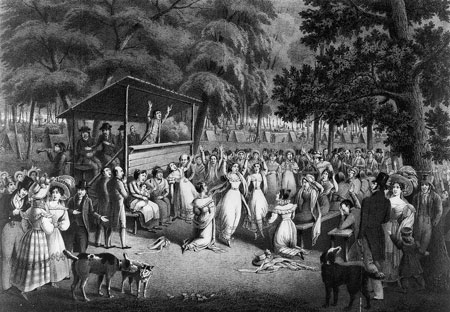
“These
efforts were bolstered by the enthusiasm of the Second Great Awakening
which was then sweeping the United States. Nearly all churches in
upstate New York conducted revivals. These were evangelistic gatherings
designed to awaken the religiously inert. Revivals were often in the
form of camp meetings held on the edge of a grove of trees or in a small
clearing in the forest. Participants often traveled many miles over
dusty or rut-filled roads to pitch their tents or park their wagons on
the outskirts of the encampment. Camp meetings frequently lasted several
days with some sessions lasting nearly all day and into the night.
Ministers rotated, but it was not uncommon to find two or three
ministers exhorting their listeners simultaneously. So fervent and
enthusiastic was the religious zeal in western New York in the early
1800s that the region came to be known as the Burned-Over District.
Because the Finger Lakes area was set figuratively ablaze with
evangelistic fire, it is not surprising that young Joseph Smith and his
family were caught up in the fervor” (Church History in the Fulness of Times, 30).
Joseph Smith–History 1:11–20
The First Vision
|
Date |
Significant Event |
|---|---|
|
Early spring 1820 |
Fourteen-year-old Joseph Smith saw the Father and the Son in a grove near the family’s log home. |
|
Early spring 1820 |
Joseph Smith told his family about his vision and they believed him. |
Joseph Smith—History 1:11–13. Why Did Joseph Go into the Woods near His Home?
Amid
the war of words and feelings that surrounded the boy Joseph, his mind
was drawn to the scriptures. He reflected upon the message of James 1:5
again and again and decided for the first time in his life to pray
vocally about the matter. After months of mental and spiritual struggle,
he finally knew what he must do. Sometime in the early spring of 1820
he went to a familiar spot in the woods near his home to make the
attempt. Joseph told an editor of the New York Spectator:
“I immediately went out into the woods where my father had a clearing,
and went to the stump where I had struck my axe when I had quit work,
and I kneeled down, and prayed” (in Allen, Improvement Era, Apr. 1970, 13).
Joseph’s “months of anguish had resulted in obvious spiritual
maturity, and he had at least three serious questions on his mind: (1)
He was concerned for his own salvation and sought forgiveness of his
sins; (2) he was concerned for the welfare of mankind in general, for,
he said, ‘I felt to mourn for my own sins and for the sins of the
world’; (3) he wanted to know which, if any, of the churches was right,
and which he should join” (Allen, Improvement Era, Apr. 1970, 9).
Joseph Smith—History 1:15–16. The Powers of Darkness
Speaking
of Joseph Smith’s experience with Satan, Elder Spencer W. Kimball, then
a member of the Quorum of the Twelve Apostles, taught: “The powers of
darkness preceded the light. When [Joseph Smith] knelt in solitude in
the silent forest, his earnest prayer brought on a battle royal which
threatened his destruction. For centuries, Lucifer with unlimited
dominion had fettered men’s minds. He could ill-afford to lose his
satanic hold. This threatened his unlimited dominion” (in Conference
Report, Apr. 1964, 98).
Joseph Smith—History 1:16–17. A Pillar of Light
Elder
Orson Pratt wrote that the pillar of light young Joseph saw descended
gradually, increasing in brightness so that “by the time it reached the
tops of the trees the whole wilderness, for some distance around, was
illuminated in a most glorious and brilliant manner. He expected to have
seen the leaves and boughs of the trees consumed, as soon as the light
came in contact with them. … It continued descending slowly, until it
rested upon the earth, and he was enveloped in the midst of it.
“… When
it first came upon him, it produced a peculiar sensation throughout his
whole system; and, immediately, his mind was caught away from the
natural objects with which he was surrounded; and he was enwrapped in a
heavenly vision” (in Allen, Improvement Era, Apr. 1970, 10).
Joseph Smith—History 1:17. The Father Introduced the Son
The
Father introduced the Son who then spoke to Joseph Smith. Elder
James E. Talmage, who was a member of the Quorum of the Twelve Apostles,
wrote: “A general consideration of scriptural evidence leads to the
conclusion that God the Eternal Father has manifested Himself to earthly
prophets or revelators on very few occasions, and then principally to
attest the divine authority of His Son, Jesus Christ” (Jesus the Christ, 39; see also Matthew 3:17; 17:5; 3 Nephi 11:7).
Joseph Smith—History 1:18–19. “Join None of Them”
Speaking of the Lord’s statement about other churches in Joseph Smith—History 1:19,
Elder Boyd K. Packer, a member of the Quorum of the Twelve Apostles,
explained: “Now this is not to say that the churches, all of them, are
without some truth. They have some truth—some of them very much of it.
They have a form of godliness. Often the clergy and adherents are not
without dedication, and many of them practice remarkably well the
virtues of Christianity. They are nonetheless, incomplete” (in
Conference Report, Oct. 1971, 8; or Ensign, Dec. 1971, 40).
Joseph Smith—History 1:20. “Many Other Things”
President Ezra Taft Benson said that “at no time did Joseph reveal everything he learned in the First Vision” (The Teachings of Ezra Taft Benson
[1988], 112). We do, however, learn from the Prophet Joseph Smith that
during the First Vision the Savior told him that “the fullness of the
Gospel should at some future time be made known unto me” (History of the Church,
4:536). In addition, he was told “many other things” that he was unable
to write, and in the 1835 account he said that he saw many angels in
his vision.
Joseph Smith–History 1:21–26
The Beginning of the Persecution of Joseph Smith
|
Date |
Significant Event |
|---|---|
|
Early spring 1820 |
Joseph told others besides his family about his vision, but many did not believe him. |
|
1820–23 |
Bitter persecution from “professors of religion” and neighbors caused Joseph great sorrow. |
Joseph Smith—History 1:21–24. Bitter Persecution
Joseph
told the story of his vision to his family. His brother William
affirmed: “We all had the most implicit confidence in what he said. He
was a truthful boy. Father and Mother believed him, why should not the
children?” (Deseret Evening News, 20 Jan. 1894, 11; see also Church History in the Fulness of Times, 34.)
Given
the tender feelings of this fourteen-year-old boy, it is little wonder
that he should wish to tell his experience to his friends and
acquaintances outside the family. One can sense his profound
disappointment when, as was recorded by Elders Orson Pratt and Orson
Hyde, he “could find none that would believe the heavenly vision” (in
Allen, Improvement Era, Apr. 1970, 11).
William Smith later reflected: “We never knew we were bad folks until
Joseph told his vision. We were considered respectable till then, but at
once people began to circulate falsehoods and stories in a wonderful
way” (Deseret Evening News, 20 Jan. 1894, 11; see also Church History in the Fulness of Times, 35).
Elder Bruce R. McConkie, a member of the Quorum of the Twelve Apostles, wrote:
“Why
should so many religionists unite against an unknown youth of no renown
or standing in the community? Would the whole sectarian world shiver
and shake and call for a sword if some other unknown fourteen-year-old
youth in an obscure frontier village should claim that he was visited by
angels and that he saw the Lord? The problem when Joseph Smith
announced such a claim was that it was true and that Lucifer knew of its
verity.
“… Is
not the persecution itself a witness of the reality of the First
Vision? Or if it were not true, would the worldly wise and the
intellectual religionists today devote their talents and means to
defaming Joseph Smith and the work that bears his imprint? What is it to
anyone else what we believe unless they in their unbelief fear lest our
doctrines are true and our practices may have divine approval?” (A New Witness for the Articles of Faith, 8–10).
Joseph Smith—History 1:25–26. “I Had Seen a Vision”
When the Old Testament prophet Samuel was young, “there was no open vision” (1 Samuel 3:1). But as Samuel grew, “the Lord was with him … and all Israel … knew that Samuel was established to be a prophet of the Lord” (vv. 19–20).
But, while all of ancient Israel accepted Samuel as a prophet, many
people in Joseph Smith’s day and today have difficulty accepting the
fact that God would speak again to a prophet on earth (see Amos 3:7).
Elder
Hugh B. Brown, then an Assistant to the Quorum of the Twelve Apostles,
related the following conversation he had with a noted judge, before the
outbreak of World War II, illustrating this point:
“I began by asking, ‘May I proceed, sir, on the assumption that you are a Christian?’
“‘I am.’
“‘I assume you believe in the Bible—the Old and New Testament?’
“‘I do!’
“‘Do you believe in prayer?’
“‘I do!’
“‘You say that my belief that God spoke to a man in this age is fantastic and absurd?’
“‘To me, it is.’
“‘Do you believe that God ever did speak to anyone?’
“‘Certainly, all through the Bible we have evidence of that.’ …
“‘Then … I am submitting to you in all seriousness that it was standard procedure in Bible times for God to talk to man.’
“‘I think I will admit that, but it stopped shortly after the first century of the Christian era.’
“‘Why do you think it stopped?’
“‘I can’t say.’ …
“‘May I suggest some possible reasons: Perhaps God does not speak to man anymore because he cannot. He has lost the power.’
“He said, ‘Of course that would be blasphemous.’
“‘Well,
then if you don’t accept that, perhaps he doesn’t speak to men because
he doesn’t love us anymore. He is no longer interested in the affairs of
men.’
“‘No,’ he said, ‘God loves all men, and he is no respecter of persons.’
“‘Well,
then, if he could speak, and if he loves us, then the only other
possible answer as I see it is that we don’t need him. We have made such
rapid strides in science, we are so well educated, that we don’t need
God anymore.’
“And
then he said, and his voice trembled as he thought of impending war,
‘Mr. Brown, there never was a time in the history of the world when the
voice of God was needed as it is needed now. Perhaps you can tell me why
he doesn’t speak.’
“My answer was, ‘He does speak; he has spoken; but men need faith to hear him’” (The Profile of a Prophet, Brigham Young University Speeches of the Year [4 Oct. 1955], 3–5).

Joseph Smith–History 1:27–54
The Angel Moroni Appeared to Joseph Smith
|
Date |
Significant Event |
|---|---|
|
1820–23 |
Young Joseph matured while suffering persecution and waiting for further instructions from the Lord. |
|
21–22 September 1823 |
Moroni first appeared to Joseph Smith. |
|
19 November 1823 |
Joseph Smith’s eldest brother, Alvin, died. |
|
1824–27 |
Joseph Smith made four annual visits to the hill where the gold plates were buried. |
Joseph Smith—History 1:27–28. Joseph Smith’s Daily Activities
Concerning
Joseph Smith’s life between the time of the First Vision and the
appearance of the angel Moroni, Elder Gordon B. Hinckley, then a member
of the Quorum of the Twelve Apostles, wrote: “His manner of living was
not greatly different from that of the ordinary farm boy of his day,
except that he was often referred to as a dreamer and was made an object
of ridicule. But he continued to work on his father’s farm, to work for
others in the area, and to associate with companions of his own age.
Those acquainted with him describe him as a strong, active boy of
cheerful disposition, who enjoyed wrestling and other sports” (Truth Restored [1947], 7).
Joseph Smith—History 1:28. The Weakness of Youth
Like
all people, Joseph faced the challenges of mortality. Because of his
weaknesses, he questioned his personal worthiness before the Lord. Other
prophets expressed similar concerns about their personal worthiness and
their weaknesses (for example, see 2 Nephi 4:17–19; Moses 6:31).
Elder Neal A. Maxwell, a member of the Quorum of the Twelve Apostles,
explained: “Just as God cannot look upon sin with the least degree of
allowance (D&C 1:31), as we become more like Him, neither can we. The best people have a heightened awareness of what little of the worst is still in them!” (Notwithstanding My Weakness, 16–17).
Joseph Smith—History 1:30. Where Did Moroni’s Visit Take Place?
In
1822, Joseph began helping his older brother Alvin build a new frame
house for the family. By September 1823, it was two stories high but
without a roof. The family, therefore, continued to live in a small log
house a short distance from the frame house. It is to the log house, not
the frame house, that Moroni went. Joseph would have undoubtedly slept
in the same room with some of his brothers, because the log house was
very small for the family of nine.
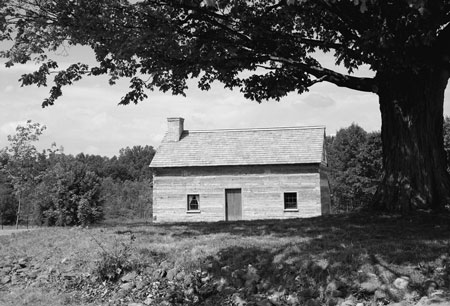
The
Church has excavated the foundation of the log house and built a
replica of it on the site. The Church also maintains the frame house in
order to help today’s visitors to the Smith family farm envision the
scenes and sense the significance of the events that took place there.
Joseph Smith—History 1:30–32. Was Moroni a Spirit or a Resurrected Being?
The Prophet Joseph Smith stated that the angel Moroni was a resurrected being (see Teachings of the Prophet Joseph Smith,119)
Joseph Smith—History 1:33. “My Name”
Elder
Neal A. Maxwell taught: “Young Joseph was told that his name would be
‘both good and evil spoken of’ throughout the world (Joseph Smith—History 1:33).
Except from a divine source, how audacious a statement! Yet his
contemporary religious leaders, then much better known than Joseph, have
faded into the footnotes of history, while the work of Joseph Smith
grows constantly and globally” (in Conference Report, Oct. 1983, 75; or Ensign, Nov. 1983, 54).
Joseph Smith—History 1:34. The Fulness of the Everlasting Gospel
Revelation 14:6–7
says that an angel would fly in the midst of heaven, having the
everlasting gospel. President N. Eldon Tanner, who was a counselor in
the First Presidency, after quoting Revelation 14:6–7,
explained: “This revelation was fulfilled and clearly understood when
the Angel Moroni did fly in the midst of heaven and appeared to Joseph
Smith and told him of the plates which contained the gospel in its
fullness” (in Conference Report, Apr. 1964, 62).
Elder
Bruce R. McConkie explained the meaning of “the fulness of the
everlasting gospel”: “According to the revealed word, the Book of Mormon
contains the fulness of the everlasting gospel; so also does the Bible,
and so do both the Doctrine and Covenants and the Pearl of Great Price.
Each of them contains the word of the gospel; each of them is a record
of God’s dealings with a people who had the fulness of the gospel; each
of them is a scriptural record that summarizes the plan of salvation and
sets forth what men must do to gain the fulness of reward in the
mansions that are prepared. The gospel itself is the power of God by
which salvation comes; it is the power that saves a human soul; and the
fulness of the gospel is all of the truths and powers needed to enable
men to gain a fulness of reward in the highest heaven of the celestial
world” (A New Witness for the Articles of Faith, 399).
Joseph Smith—History 1:34–35. What Was in the Stone Box?
In
the stone box were a book and the Urim and Thummim. The book was
written on gold plates and included the book of Lehi, the small plates
of Nephi, the plates of Mormon, and the sealed plates that Joseph was
commanded not to translate (see “A Brief Explanation about the Book of Mormon”
in the introductory pages of the Book of Mormon). The Urim and Thummim
was a divine instrument prepared by the Lord for the purpose of
translation. It consisted of two stones in silver bows and a breastplate
onto which it was attached.
Joseph Smith—History 1:36–41. What Is the Significance of the Bible Verses Moroni Quoted to the Prophet Joseph Smith?
The Prophet Joseph Smith said that Moroni quoted many passages of scriptures to him (see Joseph Smith—History 1:41). Following are the Old Testament prophecies that the Prophet specifically identified:
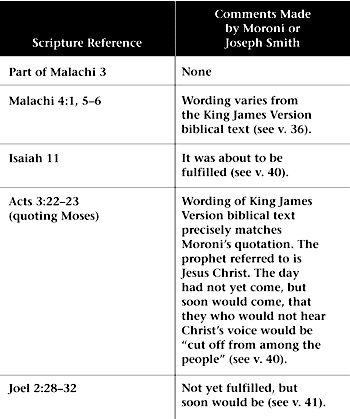
Joseph Smith also added that Moroni said “the fulness of the Gentiles was soon to come in” (v. 41). We do not know which verses Moroni quoted from Malachi 3, but verses 1–4 and 16–18 are appropriate to the themes of the other scripture references. Isaiah 11 is also quoted in 2 Nephi 21, and an explanation of parts of Isaiah 11 is in Doctrine and Covenants 113:1–6. The prophecy about Jesus Christ in Acts 3:22–23 is one of the most frequently mentioned prophecies in the scriptures (see Deuteronomy 18:15; Acts 7:37; 1 Nephi 10:4; 22:20; 3 Nephi 20:23; 21:11; D&C 133:63; Joseph Smith—History 1:40).
The
Lord taught the Nephites that prior to the Second Coming there would be
a sign given in the last days that would signal the beginning of the
gathering of Israel in power (see 3 Nephi 21:1–7). That sign is the coming forth of the Book of Mormon.
All
of the passages Moroni quoted point to the same theme: The coming forth
of the Book of Mormon will initiate a progression of events that will
lead to the Second Coming, when the wicked will be destroyed and the
righteous will reign on earth with Jesus Christ. In essence, Joseph
Smith was being told that the work he was to do would help usher in
Christ’s millennial reign and that the Savior’s coming would be “soon.”
Joseph Smith—History 1:41. Do We Know What the “Other Passages of Scripture” Are or What Other Explanations Moroni Gave?
We
gain additional insights on this matter from a letter Oliver Cowdery
wrote to W. W. Phelps, which contains an account of Moroni’s visit to
Joseph Smith: “Though fear was banished from his heart, yet his surprise
was no less when he heard him declare himself to be a messenger sent by
commandment of the Lord, to deliver a special message, and to witness
to him that his sins were forgiven, and that his prayers were heard; and
that the scriptures might be fulfilled, which say—‘God has chosen the
foolish things of the world to confound the things which are mighty; and
base things of the world, and things which are despised, has God
chosen; yea, and things which are not, to bring to nought things which
are, that no flesh should glory in his presence’ [1 Corinthians 1:27–28]” (Latter Day Saints’ Messenger and Advocate, Feb. 1835, 79).
In his account, Oliver Cowdery also cited Moroni quoting (sometimes only phrases) from Isaiah 28:21; 29:11–14; and John 10:16(see Messenger and Advocate, 79–80).
Joseph Smith—History 1:42–49. A Comparison of Moroni’s Four Visits to Joseph Smith on 21–22 September 1823
First visit (see Joseph Smith—History 1:30–43):
- •Called Joseph Smith by name
- •Introduced himself to Joseph
- •Told Joseph that God had a work for him to do
- •Told Joseph that his name would be known for good and evil among all people
- •Told Joseph about the Book of Mormon
- •Quoted Old and New Testament prophecies regarding the last days
- • Quoted many other passages of scripture
- •Offered many scriptural explanations
- •Warned Joseph not to show the plates to anyone unless commanded or he would be destroyed
- •Joseph saw in vision the place where the plates were deposited.
Second visit (see vv. 44–45):
- •Repeated what he said during the first visit “without the least variation”
- •Told Joseph that great judgments were coming upon the earth, including desolations such as famine, sword, and pestilence
Third visit (see vv. 46–47):
- •Repeated what he had said before
- •Added a caution concerning Satan’s temptation to use the gold plates to obtain wealth
- •Said Joseph must have no other motive than to glorify God and build the kingdom of God
Fourth visit (see vv. 48–49):
- •Called Joseph by name
- •Related all that he had said the night before
- •Commanded Joseph to tell his father of the vision and the commandments he had received
A
significant point in comparing the four visits of Moroni to the Prophet
Joseph Smith is the repetition of instruction. Furthermore, Moroni
seems to have discerned the thoughts and feelings Joseph was having
between each visit. For example, Moroni added instructions on the
impending end of the world during the second visit, a subject Joseph
seems most concerned about after the first visit. Then Moroni added a
warning during the third visit about Joseph’s motives in getting the
plates, a temptation Joseph could have easily experienced after the
second visit. Finally, Moroni added the commandment for Joseph to tell
his father of the visitation, a command that Joseph might have felt
impractical, or at least inconvenient, in the middle of the night.
Joseph Smith—History 1:49–50. Joseph Told His Father
Lucy
Mack Smith’s history of this event adds the following information: “The
messenger whom he saw the previous night, visited him again, and the
first thing he said was, ‘Why did you not tell your father that which I
commanded you to tell him?’ Joseph replied, ‘I was afraid my father
would not believe me.’ The angel rejoined, ‘He will believe every word
you say to him’” (History of Joseph Smith by His Mother, ed. Preston Nibley [1958], 79).
Joseph Smith—History 1:50–53. Joseph’s First Visit to the Hill Cumorah
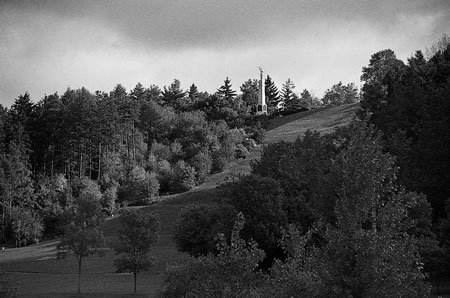
“As
Joseph approached the Hill Cumorah, he had thoughts about the poverty
of his family and the possibility that the plates or the popularity of
the translation would produce enough wealth to ‘raise him above a level
with the common earthly fortunes of his fellow men, and relieve his
family from want’ [Oliver Cowdery, in Messenger and Advocate,
July 1835, 157]. When he reached down for the plates he received a
shock and was thus prevented from taking them out of the box. Twice more
he tried and was thrown back. In frustration he cried out, ‘Why can I
not obtain this book?’ Moroni appeared and told him it was because he
had not kept the commandments but had yielded to the temptations of
Satan to obtain the plates for riches instead of having his eye single
to the glory of God as he had been commanded [Cowdery, in Messenger and Advocate, Oct. 1835, 198].
“Repentant,
Joseph humbly sought the Lord in prayer and was filled with the Spirit.
A vision was opened to him, and the ‘glory of the Lord shone round
about and rested upon him. … He beheld the prince of darkness. … The
heavenly messenger [Moroni] said, “All this is shown, the good and the
evil, the holy and impure, the glory of God and the power of darkness,
that you may know hereafter the two powers and never be influenced or
overcome by that wicked one.” … You now see why you could not obtain
this record; that the commandment was strict, and that if ever these
sacred things are obtained they must be by prayer and faithfulness in
obeying the Lord. They are not deposited here for the sake of
accumulating gain and wealth for the glory of this world: they were
sealed by the prayer of faith, and because of the knowledge which they
contain they are of no worth among the children of men, only for their
knowledge’ [Cowdery, in Messenger and Advocate,
Oct. 1835, 198]. Moroni concluded by warning Joseph that he would not
be allowed to obtain the plates ‘until he had learned to keep the
commandments of God—not only till he was willing but able to do it’ [in Lucy Mack Smith, History of Joseph Smith, 81; italics added]” (Church History in the Fulness of Times, 40–41)
Joseph Smith—History 1:54. Joseph’s Annual Visits to the Hill
Between
1823, when Joseph first saw the plates, and 1827, when he was allowed
to take them from the hill, Joseph received additional heavenly
instruction. Lucy Mack Smith’s history says that during this time,
Joseph “continued to receive instructions from the Lord” (History of Joseph Smith,
82). President John Taylor said: “When Joseph Smith was raised up as a
Prophet of God, Mormon, Moroni, Nephi and others of the ancient Prophets
who formerly lived on this Continent, and Peter and John and others who
lived on the Asiatic Continent, came to him and communicated to him
certain principles pertaining to the Gospel of the Son of God” (in Journal of Discourses, 17:374).
Joseph
Smith’s mother also wrote: “During our evening conversations, Joseph
would occasionally give us some of the most amusing recitals that could
be imagined. He would describe the ancient inhabitants of this
continent, their dress, mode of traveling, and the animals upon which
they rode; their cities, their buildings, with every particular; their
mode of warfare; and also their religious worship. This he would do with
as much ease, seemingly, as if he had spent his whole life among them” (History of Joseph Smith, 83).
Joseph Smith–History 1:55–65
Joseph Smith Received the Gold Plates
|
Date |
Significant Event |
|---|---|
|
October 1825 |
Joseph met Emma Hale while working for Josiah Stoal |
|
18 January 1827 |
Joseph married Emma Hale |
|
22 September 1827 |
Joseph received the Book of Mormon plates |
|
February 1828 |
Martin Harris visited Charles Anthon in New York City |
|
7 April 1829 |
Joseph resumed translating the plates, with the help of Oliver Cowdery |
Joseph Smith—History 1:56. Joseph’s Brother, Alvin Smith
“Alvin
was a faithful and serious young man, and Joseph idolized him. Joseph
saw in him a guileless person who lived an upright life. Alvin loved
Joseph, too, and was greatly interested in the sacred record. As death
neared he counseled Joseph: ‘I want you to be a good boy, and do
everything that lies in your power to obtain the Record. Be faithful in
receiving instruction, and in keeping every commandment that is given
you’ [in Lucy Mack Smith, History of Joseph Smith, 87]. Joseph learned by revelation years later that Alvin was an heir to the celestial kingdom (see D&C 137:1–6)” (Church History in the Fulness of Times, 42).
Joseph Smith—History 1:55–56. Money-Digging
Concerning Joseph’s money-digging for Josiah Stoal, Joseph’s mother, Lucy Mack Smith, wrote the following in her history:
“A
man by the name of Josiah Stoal came from Chenango county, New York,
with the view of getting Joseph to assist him in digging for a silver
mine. He came for Joseph on account of having heard that he possessed
certain means by which he could discern things invisible to the natural
eye.
“Joseph
endeavored to divert him from his vain pursuit, but he was inflexible
in his purpose and offered high wages to those who would dig for him in
search of said mine, and still insisted upon having Joseph to work for
him. Accordingly, Joseph and several others returned with him and
commenced digging. After laboring for the old gentleman about a month,
without success, Joseph prevailed upon him to cease his operations, and
it was from this circumstance of having worked by the month, at digging
for a silver mine, that the very prevalent story arose of Joseph’s
having been a money digger” (History of Joseph Smith, 91–92).
Joseph Smith—History 1:57–58. Emma Hale
“[Emma]
was born in Harmony on July 10, 1804. She is reported to have been a
beautiful woman, above average in size, dignified in body, with
‘bewitching dark eyes’ and raven hair. She was an attractive
personality, intelligent and capable. For one year she attended an
academy for girls where she received training in social behavior. It was
said of her that she ‘never used slang and was very particular about
her grammar and choice of words.’ She had the reputation of being a
meticulous housekeeper and an excellent cook. She, like her mother, was a
member of the Methodist Church, had a good singing voice, and sang in
the village choir” (Ivan J. Barrett, Joseph Smith and the Restoration, [1973], 71).
Joseph Smith’s mother, Lucy Mack Smith, wrote:
“While
Joseph was in the employ of Mr. Stoal, he boarded a short time with one
Isaac Hale, and it was during this interval that Joseph became
acquainted with his daughter, Miss Emma Hale, to whom he immediately
commenced paying his addresses, and was subsequently married. …
“… Joseph called my husband and myself aside and said, ‘I have
been very lonely ever since Alvin died and I have concluded to get
married, and if you have no objections to my uniting myself in marriage
with Miss Emma Hale, she would be my choice in preference to any other
woman I have ever seen.’ We were pleased with his choice and not only
consented to his marrying her, but requested him to bring her home with
him and live with us” (History of Joseph Smith, 92–93).
Joseph Smith—History 1:59–60. Joseph Received the Plates
“Little
is known of Joseph’s visits with Moroni between 1824 and 1827, but
sometime before fall of 1827, Joseph returned home one evening later
than usual. His family was concerned, but he told them he had been
delayed because he had just received a severe chastisement from Moroni.
He said that as he passed by the Hill Cumorah, ‘The angel met me and
said that I had not been engaged enough in the work of the Lord; that
the time had come for the record to be brought forth; and that I must be
up and doing and set myself about the things which God had commanded me
to do’ [Smith, History of Joseph Smith, 100].
“Much
must have transpired in Joseph’s four years of preparation. He passed
through his teens largely untainted by the precepts of men. He enjoyed
the emotional support of his family, and he took on the responsibilities
associated with marriage. Angels prepared him to translate a divinely
inspired record and taught him the necessity of self-discipline and
obedience. He was undoubtedly anxious to begin translating the Book of
Mormon. At this time Joseph Knight and Josiah Stowell were in Manchester
visiting with the Smith family. This might have been in anticipation of
Joseph’s receiving the plates.
“Long
before sunrise on 22 September 1827, Joseph and his wife hitched Joseph
Knight’s horse to Josiah Stowell’s spring wagon and drove the three
miles to the Hill Cumorah. Leaving Emma at the base, Joseph climbed the
hill for his final interview with Moroni. Moroni gave him the plates,
the Urim and Thummim, and the breastplate. He also gave Joseph a
specific warning and promise concerning his responsibilities. Joseph was
now responsible for these sacred objects, and if he was careless or
negligent and lost them he would be cut off. On the other hand, if he
used all his efforts to preserve them until Moroni returned for them, he
was assured that they would be protected (see Joseph Smith—History 1:59).
“For
the first time in over fourteen hundred years the precious records were
entrusted to a mortal. Joseph carefully hid the plates in a hollow log
near his home. The Prophet’s friends were not the only ones who eagerly
anticipated his receiving the plates. Others in the neighborhood had
heard that Joseph was going to bring home valuable metal plates. …
Joseph soon learned why Moroni had strictly charged him to protect the
plates. ‘Every stratagem that could be invented’ was used to get them
from him (v. 60).
For example, Willard Chase, a neighboring farmer, along with other
treasure seekers, sent for a sorcerer to come and find the place where
the plates were hidden. When the Smiths learned of the plot they sent
Emma to get Joseph, who was working in Macedon a few miles west of
Palmyra. He returned immediately and retrieved the plates. Wrapping them
in a linen frock, he started through the woods, thinking it might be
safer than the traveled road. But just as he jumped over a log, he was
struck from behind with a gun. Joseph, however, was able to knock his
assailant down and flee. Half a mile later he was assaulted again but
managed to escape, and before he arrived home he was accosted a third
time. His mother said that when he reached home he was ‘altogether
speechless from fright and the fatigue of running’ [History of Joseph Smith, 108].
“Efforts
to steal the plates intensified, but Moroni’s promise of protection was
also fulfilled. Joseph often moved the plates from their hiding place
just minutes before the treasure seekers arrived. Once he hid them under
the hearthstone of the fireplace of his home. A large group of men
gathered in front of the house, but they scattered when Joseph and his
brothers faked a counterattack by running out the front door screaming
and yelling as if a large company of men were assisting them. Joseph
then hid the chest under the wooden floor of the cooper shop on the
Smith farm, but he was prompted to conceal the records themselves under
the flax in the loft. That night his enemies tore up the floor of the
cooper shop, but the plates remained safe” (Church History in the Fulness of Times, 43–45).
Joseph Smith—History 1:60. Attempts to Get the Plates from Joseph
Elder
Gordon B. Hinckley, then a member of the Quorum of the Twelve Apostles,
wrote: “Joseph soon learned why Moroni had charged him so strictly to
guard the record taken from the hill. No sooner was it rumored that he
had the plates than efforts were made to seize them from him. To
preserve them he first carefully hid them in a hollow birch log. Then he
locked them in a chest in his father’s home. Later they were buried
beneath the hearthstone of the family living room. A cooper’s shop
across the street was their next hiding place. All of these and other
stratagems were employed to keep them safe from neighborhood mobs who
raided and ransacked the Smith home and surrounding premises, and even
employed the services of a diviner in their zeal to locate the record” (Truth Restored, 13–14).
Joseph Smith—History 1:61–62. Preserving the Plates
“The
Smiths continued to be harassed, and the Prophet had to resort to
numerous hiding places. Joseph Smith first placed them in Hyrum’s chest,
then, at various times, secreted the plates under the hearth of his
father’s home, in a pile of flax in the cooper’s loft, in Father Beman’s
Ontario glass box, and in Emma’s red Morocco trunk [see Smith,History of Joseph Smith, 112–13].
“However,
Joseph Smith’s calling was not merely to preserve the gold plates, but
also to translate them. With people in the area around Manchester so
intent on stealing the plates, Joseph and Emma decided to move to
Harmony to live on her father’s farm. They hoped to have the necessary
peace there to accomplish the divine task. Martin Harris gave Joseph $50
to make the move, and Emma’s brother Alva lent them a team and wagon.
They left after hiding the record in a barrel of beans in the wagon.
Several men detained the travelers but were unsuccessful in finding the
plates. [See Richard L. Bushman, Joseph Smith and the Beginnings of Mormonism (1984), 85.]
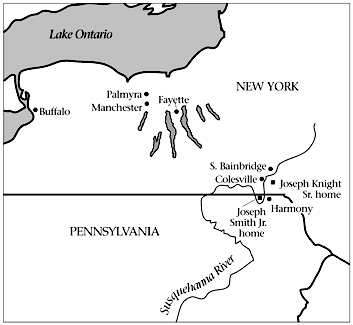
“In
Harmony, the couple moved into a two-room house owned by Jesse, another
of Emma’s brothers, about 150 yards from Isaac Hale’s house. The
Prophet was ready to begin the translation. On at least six different
occasions, Joseph Smith gave brief descriptions of how he translated the
Book of Mormon. All six accounts agree that he translated them by the
gift and power of God, through the Urim and Thummim [see Joseph Smith—History 1:62; D&C 9:4–12; Warren Cowdery, Manuscript History of the Church, Book A-1, in LDS Church Archives, 121–22; Elder’s Journal, 1 July 1838, 43; Times and Seasons, 3 May 1842, 772; and Times and Seasons, 4 Nov. 1843, 373]” (Kenneth W. Godfrey, “A New Prophet and a New Scripture: The Coming Forth of the Book of Mormon,” Ensign, Jan. 1988, 11).

Joseph Smith—History 1:63–65. Prophecy Fulfilled
See Isaiah 29:11–12 and 2 Nephi 27:6–26.
Elder James E. Talmage, who was a member of the Quorum of the Twelve
Apostles, wrote: “Joseph began his work with the plates by patiently
copying a number of characters, adding his translation to some of the
pages thus prepared. The prophet’s first assistant in the labor, Martin
Harris, obtained permission to take away some of these transcripts, with
the purpose of submitting them to the examination of men learned in
ancient languages. He placed some of the sheets before Professor Charles
Anthon, of Columbia College, who, after examination, certified that the
characters were in general of the ancient Egyptian order, and that the
accompanying translations appeared to be correct. Hearing how this
ancient record came into Joseph’s hands, Professor Anthon requested Mr.
Harris to bring the original book for examination, stating that he would
undertake the translation of the work; then, learning that a part of
the book was sealed, he remarked, ‘I cannot read a sealed book’; and
thus unwittingly did this man fulfil the prophecy of Isaiah concerning
the coming forth of the volume: ‘And the vision of all is become unto
you as the words of a book that is sealed, which men deliver to one that
is learned, saying, Read this, I pray thee: and he saith, I cannot; for
it is sealed’ [Isaiah 29:11].
Another linguist, a Doctor Mitchell, of New York, having examined the
characters, gave concerning them a testimony in all important respects
corresponding to that of Professor Anthon” (The Articles of Faith, 267–68).
Joseph Smith–History 1:66–75
Joseph Smith Received the Priesthood of God
|
Date |
Significant Event |
|---|---|
|
15 May 1829 |
John the Baptist restored the Aaronic Priesthood |
|
May or June 1829 |
Peter, James, and John restored the Melchizedek Priesthood |
Joseph Smith—History 1:66–67. Oliver Cowdery
“Oliver
Cowdery was born 3 October 1806 in Wells, Rutland County, Vermont. He
was the youngest of eight children. As he grew up he received an
education consisting of reading, writing, and the basic rules of
arithmetic. Several of the elder Cowdery brothers had found that
business opportunities were limited in Vermont and had moved to western
New York. In 1825 Oliver followed and took employment as a clerk in a
village general store. He also engaged in blacksmithing and farming.
Oliver was slight of build, about five feet five inches tall, with dark,
wavy hair and piercing dark eyes.
“Early
in 1829 one of Oliver’s older brothers, Lyman Cowdery, was hired to
teach at the village school in Manchester township close to where Joseph
Smith’s family lived. Lyman was unable to fulfill his commitment and
suggested that the trustees hire his brother Oliver. Approved by the
trustees, one of whom was Hyrum Smith, Oliver commenced teaching and was
invited to board at the home of Joseph Smith, Sr. Lucy Smith related
that almost immediately ‘he began to hear from all quarters concerning
the plates, and as soon began to importune Mr. Smith upon the subject,
but for a considerable length of time did not succeed in eliciting any
information’ [History of Joseph Smith, 138]. The Smiths were reluctant to share their experiences because they had been ridiculed by neighbors in the past” (Church History in the Fulness of Times, 52–53).
Oliver
Cowdery pressed the Smiths for more information about Joseph and the
Book of Mormon. Lucy Smith’s memoirs indicate that Oliver became
obsessed with the story and insisted on traveling with Samuel Smith
(Joseph’s brother) when he went to Harmony, Pennsylvania, to visit the
Prophet. Oliver had prayed for understanding and felt there was a work
for him to do with Joseph. Oliver Cowdery arrived in Harmony on Sunday,
5 April 1829, and Joseph recognized him as the assistance the Lord had
promised. They sat down together and discussed Joseph’s experiences
until late in the evening. The next day they attended to some business,
and on Tuesday, 7 April, they commenced the work of translation.
Regarding
his experiences working with Joseph Smith, Oliver later reminisced:
“These were days never to be forgotten—to sit under the sound of a voice
dictated by the inspiration of heaven, awakened the utmost gratitude of
this bosom! Day after day I continued, uninterrupted, to write from his
mouth, as he translated with the Urim and Thummim” (Joseph
Smith—History endnote).
Joseph Smith—History 1:67. The Translation of the Book of Mormon
Concerning
his translating the Book of Mormon, the Prophet Joseph Smith explained:
“With the records was found a curious instrument, which the ancients
called ‘Urim and Thummim,’ which consisted of two transparent stones set
in the rim of a bow fastened to a breast plate. Through the medium of
the Urim and Thummim I translated the record by the gift and power of
God” (History of the Church, 4:537).
“Joseph
and Oliver labored ‘with little cessation’ on the translation
throughout April. With Oliver’s help, Joseph proceeded faster than ever
before. During the next three months Joseph and Oliver completed the
amazing task of translating approximately five hundred printed pages.
This was a glorious period in their lives” (Church History in the Fulness of Times, 53).
Joseph Smith—History 1:68–74. Aaronic Priesthood Restored
On
22 September 1823, the Angel Moroni announced: “When they [the gold
plates] are interpreted the Lord will give the holy priesthood to some,
and they shall begin to proclaim this gospel and baptize by water, and
after that they shall have power to give the Holy Ghost by the laying on
of their hands” (in Oliver Cowdery, Messenger and Advocate, Oct. 1835, 199).
As
Joseph and Oliver translated the Book of Mormon they came to the
Savior’s visit to the inhabitants of the western hemisphere and His
teachings about baptism (see 3 Nephi 11:18–41).
They determined to go to the Lord in mighty prayer to learn how they
could obtain the blessing of baptism. On 15 May 1829, Joseph and Oliver
went into the nearby woods along the Susquehanna River to pray. Oliver
described their experience: “On a sudden, as from the midst of eternity,
the voice of the Redeemer spake peace to us, while the veil was parted
and the angel of God came down clothed with glory, and delivered the
anxiously looked for message, and the keys of the Gospel of repentance.
What joy! what wonder! what amazement! While the world was racked and
distracted … our eyes beheld, our ears heard” (Joseph Smith—History
endnote).
John
the Baptist appeared and restored the Aaronic Priesthood and
significant spiritual manifestations attended Joseph’s and Oliver’s
baptism (see Joseph Smith—History 1:73–74).
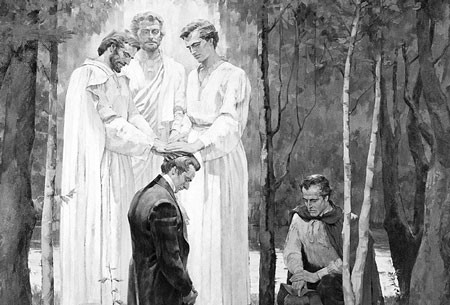
Joseph Smith—History 1:72. Restoration of the Melchizedek Priesthood
Soon
after John the Baptist conferred the Aaronic Priesthood on Joseph and
Oliver, “the Lord’s chief Apostles, Peter, James, and John, appeared to
them on the banks of the Susquehanna River (see D&C 128:20). The angelic visitors conferred upon Joseph and Oliver the holy Melchizedek Priesthood and the keys of the apostleship (see D&C 27:12). Joseph and Oliver now had the authority to act as legal agents for the Lord in building the kingdom of God upon the earth” (Church History in the Fulness of Times, 56). This restoration most probably occurred between 16–28 May 1829 (see Larry C. Porter, “The Restoration of the Aaronic and Melchizedek Priesthoods,”
Ensign, Dec. 1996, 33–47).
President
Wilford Woodruff explained: “Joseph Smith never attempted to organize
this Church until he received commandment so to do from God. He never
attempted to baptize a man until he received the Aaronic priesthood
under the hands of John the Baptist. … He never attempted to officiate
in any of the ordinances of the Gospel until he received the Apostleship
under the hands of Peter, James and John. These men appeared to him.
They laid their hands upon his head and sealed the Apostleship upon him
with all the power thereof” (in Journal of Discourses, 24:241).
On
13 January 1849, Oliver Cowdery penned the following lines at the
request of Samuel W. Richards, who was hosting Oliver and his wife in
the Richards home in the upper part of Missouri:
“While
darkness covered the earth and gross darkness the people; long after
the authority to administer in holy things had been taken away, the Lord
opened the heavens and sent forth his word for the salvation of Israel.
In fulfillment of the sacred scriptures, the everlasting gospel was
proclaimed by the mighty angel (Moroni) who, clothed with the authority
of his mission, gave glory to God in the highest. This gospel is the
‘stone taken from the mountain without hands.’ John the Baptist, holding
the keys of the Aaronic priesthood; Peter, James and John, holding the
keys of the Melchizedek priesthood, have also ministered for those who
shall be heirs of salvation, and with these administrations ordained men
to the same priesthood. These priesthoods, with their authority, are
now, and must continue to be, in the body of the Church of Jesus Christ
of Latter-day Saints. Blessed is the elder who has received the same,
and thrice blessed and holy is he who shall endure to the end.
“Accept
assurances, dear brother, of the unfeigned prayer of him who, in
connection with Joseph the Seer, was blessed with the above ministration
and who earnestly and devoutly hopes to meet you in the celestial
glory” (in B. H. Roberts, New Witnesses for God, 3 vols. [1909–11], 2:289–90).
Bishop
Joseph L. Wirthlin, then Presiding Bishop of the Church, explained: “By
divine direction, the Apostolic Presidency, Peter, James, and John
bestowed upon Joseph Smith and his associate the Melchizedek Priesthood
which holds the keys of loosening and binding both upon the earth and in
the heavens, the laying on of hands for the gift of the Holy Ghost, the
keys to preach the gospel to every nation, kindred, tongue and people,
the keys for the work for the dead, and, hence, the relationship which
existed between the prophets and apostles of old was established in this
day to the end that the Lord’s plans for the eternal blessing of his
children might be brought into fruition” (in Conference Report, Apr.
1954, 4; see also Matthew 16:13–19; 17:3; John 15:16; Teachings of the Prophet Joseph Smith, 157–58).

No comments:
Post a Comment